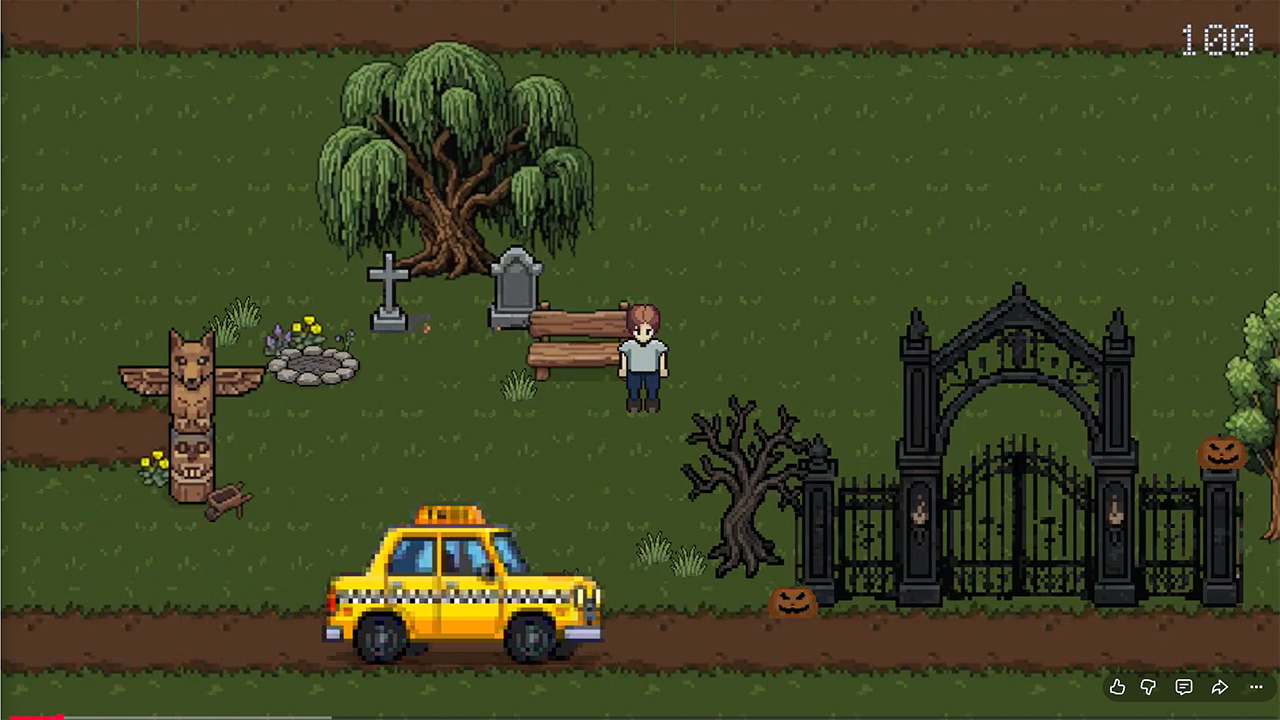
Pretty Kitty Gone is a 2D top-down Halloween game about an engineering student, a hairless cat and a graveyard full of things that want to bite him.
Phil and I have been buildingthis game since August. This post covers how Pretty Kitty Gone came together, who did what, where AI did the work and where it didn’t, and what the 2026 numbers say about selling an AI-assisted game on Steam.
What is Pretty Kitty Gone?
Simon Margin has one job. Lauren Recall is off to visit her mum at St Felix Hospital, and she has left Simon in charge of Pretty Kitty, her two-year-old Sphynx cat (we will probably change this). Fifteen seconds after the taxi pulls away, Pretty Kitty was sitting on is emptis off. She’s gone over the fence into the creepy cemetery next door.
You have to get her back.
The graveyard on Graveyard Avenue is home to Skelingtons, Ghosties and Bitey Vampyres, and Simon has no weapon. He can’t fight. He can only run, dodge and think.
You start with 100 points:
- A bat bites you: lose 2 points.
- A ghost drains your energy: lose 5 points.
- A skeleton slashes you with its sword: lose 10 points.
Hit zero and it’s over. No Kitty. No Simon.
The trick: skeletons kill ghosts and bats. Lead a swarm into a skeleton and let it do the dirty work.
We wanted a game a young kid can pick up straight away, with enough going on that a teenager can play it smart. Running away is easy to learn. Running away well, while luring a ghost into a skeleton’s sword, takes a bit more.
Who made Pretty Kitty Gone
- Story, characters and dialogue: Phil, our writer.
- Design, build and testing: me (Edwin), in Unity.
- Code: written by AI (Bezi AI and Claude), directed and tested by me.
- Voices: AI, generated with ElevenLabs.
- Pixel art: asset packs bought from indie pixel artists.
- Music: human-made. I tried an AI track on day one, and a real piano piece beat it easily.
Phil: the writer
Phil built the world before there was a game to put it in. Lauren studies occupational therapy, is a killer darts player and sings her cat to sleep every night. Simon is an engineering student who converted an old ride-on mower into a licensed SUV. Pretty Kitty waits until Lauren nods off, then goes exploring, and the cemetery caretaker, Nigel Final, likes her more than any living person.
Phil also wrote every line of dialogue. Here’s how the game opens:
SIMON: What does she eat?
LAUREN: Human souls.
SIMON: (laughs) That’s a surprise.
LAUREN: Actually, she eats a can of Fish Mist. It’s in the pantry.
The caretaker, Nigel Final, has some of the best lines (“Look at the filthy stars and all that dirty space!”), and the skeleton was written with a German accent and a lot to say about his sword.
Phil is no fan of AI.
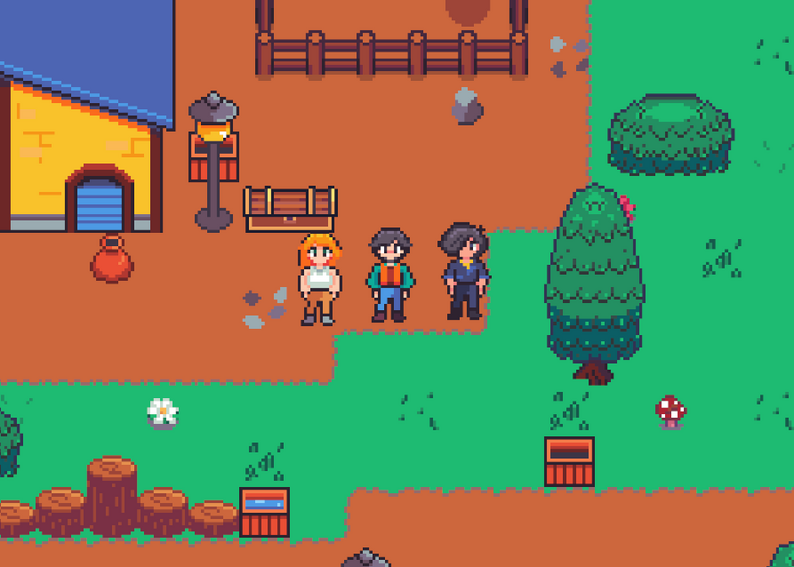
On our Game Development & AI podcast he calls it “Evil AI” and worries about people’s likeness rights. That tension runs through this whole project, and it’s a healthy one. The story and dialogue in Pretty Kitty Gone are his.
Me: the build
I’m the developer. The code was written by AI: Bezi AI inside Unity, and then with Claude.
My job was deciding what the game should do, describing it clearly, testing what came back and pulling it all together. It’s a different skill from writing every line yourself, and it’s very fast. More on that below.
The voices
Simon and the monsters are voiced with ElevenLabs on a basic plan. Simon uses a voice called Wilf and drops random lines as you play. The bats got no voice at all. With a dozen of them flapping about, it would have been too much.
The art and music
All the pixel art comes from asset packs made by indie artists: a 32×32 graveyard, farm and buildings set picked up in a sale, plus a Sphynx cat sprite.
The music started as an AI track, got replaced by a human-made piano piece, then a chiptune version, and I’m still hunting for something genuinely 8-bit and spooky. Preferably human-made.
How we made Pretty Kitty Gone, step by step
1. Story first (August)
The early scene notes had Simon kicking skeletons in the breastbone until they fell apart “like a busted Jenga tower”, ghosts freezing him for two seconds at a time, and the caretaker watching silently from the shadows. Most of that didn’t survive contact with a game engine.
At the time I’d noted that the small-game developers worth learning from (the ones shipping lots of little games from game jams) almost never start with story. We did anyway. In hindsight, the story gave us characters and a tone worth keeping, but the scene-by-scene plot was more than a first small game could carry. Next time: build the core loop first, then let the writing grow around it.
2. Day one: from placeholder to Simon (1 September)
By 7:49am on 1 September I had a dummy level running with placeholder graphics. By the end of the day:
- the placeholder was Simon, with walking animations
- Pretty Kitty had an escape route set by waypoints, plus meows
- a skeleton rose out of its grave as Simon walked past
- Simon had a voice and random lines
- Xbox controller support was sorted
- I’d started experimenting with lamplight to make it spookier.
That was 6.5 hours of work.
3. Filling the graveyard (2–6 September)
A ghost that appears when Simon goes near a chest, with dialogue and a follow speed. A vampire animation (fiddly). A skeleton attack with a sword whoosh. Bats. Then a HUD with points and game-over music. Total time so far: about 9 hours.
4. Better art, bigger graveyard (19–28 September)
I found a much better 32×32 pixel art set, so I used Bezi’s planning tool to replan the level around it. Then came a new layout, a cat that actively dodges you, and more bats, skeletons and ghosts. By the end of the King’s Birthday long weekend, my dev log said 20.5 hours.
Alongside all that, Phil and I have met for an hour a week, every week, for eight weeks. That hour is where the game gets decided.
5. Playtesting: what Phil felt and what the data said
Phil played three short games and sent a report. Following the cat was easy. He put Simon right on top of Pretty Kitty three times and nothing happened. In another run, he never got near her at all. He could see the ghosts but didn’t feel them.

He also had ideas:
- an exit screen
- a pause screen that reads PAWS on the 13th press
- swapping the Sphynx for a fluffy black cat (the Sphynx sprite was drawn for a 16×16 world and doesn’t sit well in our 32×32 one)
- more Halloween dressing: spider webs, a cauldron of lollies, a witch’s hat, candles, old tomes.
I’d also built telemetry into the game. Every test run writes a log of where Simon, the cat and every monster are, 50 times a second. I had Claude analyse 18 of those logs: about 43 minutes of play, 14 complete runs, between 29 September and 6 October. Here’s what it found:
- Nobody won. Not once. Catching the cat was switched off in the code. Simon reached catching distance in 9 of the 14 runs, and nothing happened. Phil was right.
- Runs were short. The median run lasted about two minutes.
- One tree stump did most of the damage. 41% of all hits happened around a hollow stump where three bats spawn on top of each other and bite in sync.
- Bats were invisible damage. They landed about 60% of all hits, but Simon doesn’t flash when a bat bites, so players barely noticed.
- One ghost, one death. In one run, a single ghost moving at a third of Simon’s speed drained all 100 points.
- People kept playing anyway. One morning saw 10 runs in 32 minutes, most restarted within five seconds of game over.
That last point is the best news in the report. Even with no way to win, people hit restart straight away.
The lesson: watch people play, and log what they do. Phil told us what it felt like. The logs told us why.
6. What changed, and what’s queued
Pretty Kitty Gone has already moved a long way from the first design. Simon no longer fights, and running away is now the heart of the game. The enemy roster and points have been reworked more than once along the way.
Next on the list:
- switch catching on and add a proper win screen
- make Pretty Kitty easier to find once she bolts
- make every hit obvious, with a flash, a sound and a brief moment of safety afterwards
- break up the bat stump
- if two minutes isn’t enough to corner a cat that’s faster than you, add an easy mode.
How AI is affecting the sale of Steam games
Steam is where small games go to be found, or lost. Since we used AI to make Pretty Kitty Gone, we looked at what the 2026 data says about AI and sales.
The flood
Sulka Haro ran a census of about 53,600 Steam releases from mid-2023 to mid-2026. Games with an AI disclosure went from 10.9% of releases in 2024 to 19.9% in 2025, and 30.8% in 2026 so far. That’s around 530 AI-flagged launches a month, and they account for most of Steam’s growth in release numbers. If the trend holds, half of all new Steam games will carry an AI label sometime in 2027–28.
The sales
AI games are about a third of launches but only an estimated 10–27% of sales. In Haro’s data, an AI-flagged game reaches 100+ reviews (roughly 3,000 sales) at only about 55% of the rate of a non-AI game, and that ratio hasn’t improved in two years. Steam was brutal long before AI: the top 1% of games take about 94% of estimated revenue.
Game Oracle studied 9,879 games released in 2025. After controlling for publisher, developer experience and genre, games that disclosed AI got about 53% fewer reviews. Among games with 100+ reviews, the AI ones also rated lower (84.6% positive vs 88.3%). Interestingly, the penalty landed hardest on experienced studios. Weak games sell poorly either way.
What players say vs what they do
A Quantic Foundry survey found 85% of the gamers it asked were negative about generative AI in games. They were most negative about art, music, sound, story and dialogue. But in a GameDiscoverCo poll of Steam players, only 8% said they’d refuse to buy any game with an AI disclosure, and 43% were fine with it. Players are loud about AI. Their wallets are quieter.
AI voices in particular
ARC Raiders launched with AI text-to-speech voices for some characters and copped heavy criticism. It still sold more than four million copies in its first month. Later, Embark re-recorded some of those lines with human actors. Studio head Patrick Söderlund put it simply: “A real professional actor is better than AI.”
The rules
In January 2026, Valve rewrote Steam’s AI disclosure form. AI tools used behind the scenes, such as coding assistants, no longer need disclosing. AI content that players see, hear or read still does: art, voices, story text and translations.
What that means for Pretty Kitty Gone
Under Valve’s rules, our AI-written code doesn’t need a label. Our AI voices do.
Voices sit in the category players dislike most. But Haro’s data has a twist. Among AI-flagged games, the commercial successes were three times more likely to disclose AI voices than the flops (24% vs 8%). The flops leaned on AI art (72% vs 57%), usually with a one-line disclosure. The successes wrote longer, more specific disclosures and were more likely to mention human review.
So if Pretty Kitty Gone goes to Steam, the disclosure should say exactly what we did: AI-assisted code, AI-generated voices, and human-made story, dialogue, art and music. And if the game earns it, the voices are the first thing worth re-recording with real actors.
None of that matters if the game isn’t fun. Both studies point the same way: AI doesn’t rescue a weak game, and a label hurts most when everything else is good. The best defence is making the human parts obvious: Phil’s writing, hand-made pixel art, and a cat you actually want to catch.
What’s next for Pretty Kitty Gone
Turn catching on, add a win screen, and run the next round of playtests with better logging. We’re working towards the Halloween ’26 Edition. Follow along here and on the podcast. We’ll share the next playtest results, good and bad.
Sources
- Sulka Haro: Three years of AI on Steam (July 2026)
- Notebookcheck: Study suggests AI is hurting video game sales (Game Oracle)
- Tech4Gamers: AI use in games and sales (Game Oracle)
- GamesMarket: Quantic Foundry survey on gen AI in games
- Gamereactor: Only 8% of Steam users say they wouldn’t buy a game with AI
- Top Gear: ARC Raiders’ AI voice acting
- Players: ARC Raiders replaces some AI voice lines with real actors
- Notebookcheck: Steam updates AI disclosure form (January 2026)
Leave a Reply